Research & evidence

A learning institution states what it knows, what it doesn't, and what would change its mind.

Masters maintains dated, provenance-preserving evidence about vendors and architectures, publishes its methodology and competitive analysis, and marks uncertainty and negative results plainly. The Masters Guide draws on this evidence base; it does not invent facts to fill a report.

Every claim carries its date Negative results published Research posture, not sales posture

Primary research thesis · active

Governed Institutional Intelligence

The institution — not AI — is the enduring intelligence system. AI should strengthen what the institution knows, remembers, governs, and can continue, rather than quietly becoming the place where those capabilities live.

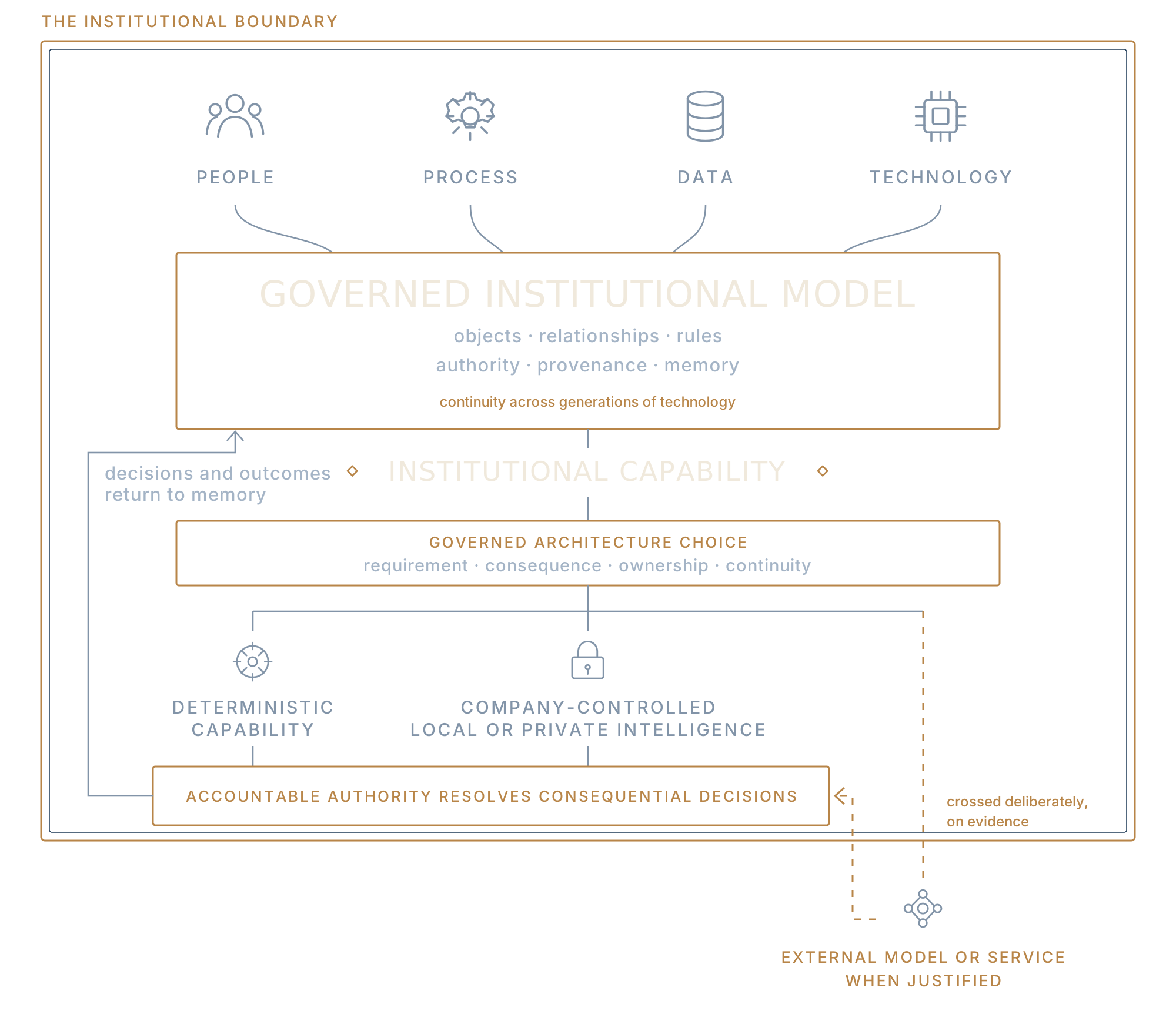
People, process, data and technology converge into a governed institutional model — objects, relationships and rules; authority, provenance and memory; and continuity across generations of technology. The model produces institutional capability, delivered through capability modes chosen as a governed architecture decision against the requirement, the consequence, what must remain company-controlled, and what continuity is required. The modes are alternatives to be combined as appropriate, not a fixed priority order: deterministic capability; company-controlled local or private intelligence; and an external model or service when justified, which is the branch that deliberately crosses the institutional boundary. Accountable human authority retains and resolves consequential decisions, and decisions and outcomes return to institutional memory.

What we are studying

Organizations accumulate intelligence across people, procedures, systems, decisions, data, relationships, and institutional memory. An institution should not make its continuity dependent on one model, one vendor, one employee, or one technology generation.

The research question is what a governed model of the institution itself would have to contain — what exists, how things relate, what rules apply, who holds authority, what happened, what changed, and what must remain portable and under institutional control — and whether maintaining such a model measurably improves institutional judgment over time.

Truth boundary

Governed Institutional Intelligence is an active Masters research thesis, not a validated commercial offering. It is published here as hypotheses and open questions. Naming an idea does not strengthen the evidence for it, and Masters does not sell GII as a proven product.

Working hypotheses · under study

Explanatory language, held to the standard of evidence.

These are the terms Masters uses to describe what it is investigating. Each is explanatory language for a risk or mechanism under study — not a measured finding.

  1. 01

    Capability liquidation

    An institution can purchase short-term efficiency by outsourcing the very work through which its own people used to become capable.

    Open question: how would an institution detect this early, and what measurement would distinguish genuine leverage from quiet erosion?

  2. 02

    Silent failure

    A system whose behavior changes underneath the institution can keep producing confident output while its reliability degrades unobserved.

    Open question: what monitoring makes a behavioral change visible before it becomes a business consequence?

  3. 03

    Externally purchased intelligence is a non-stationary dependency

    A capability that can change behavior while you depend on it is different in kind from one you own and can hold still.

    Open question: which classes of work can tolerate non-stationarity, and which cannot?

  4. 04

    Graceful institutional degradation

    Systems should be designed to weaken in defined steps rather than fail silently when a provider, network, or model changes.

    Open question: what is the minimum viable fallback for a consequential workflow, and who owns testing it?

  5. 05

    The trickle-up effect

    A hypothesis, clearly marked as such, that strengthening capability at the working level improves institutional judgment above it.

    Open question: is there any way to observe this that is not confounded by selection effects?

Continuity and institutional control

What should happen when the ground moves.

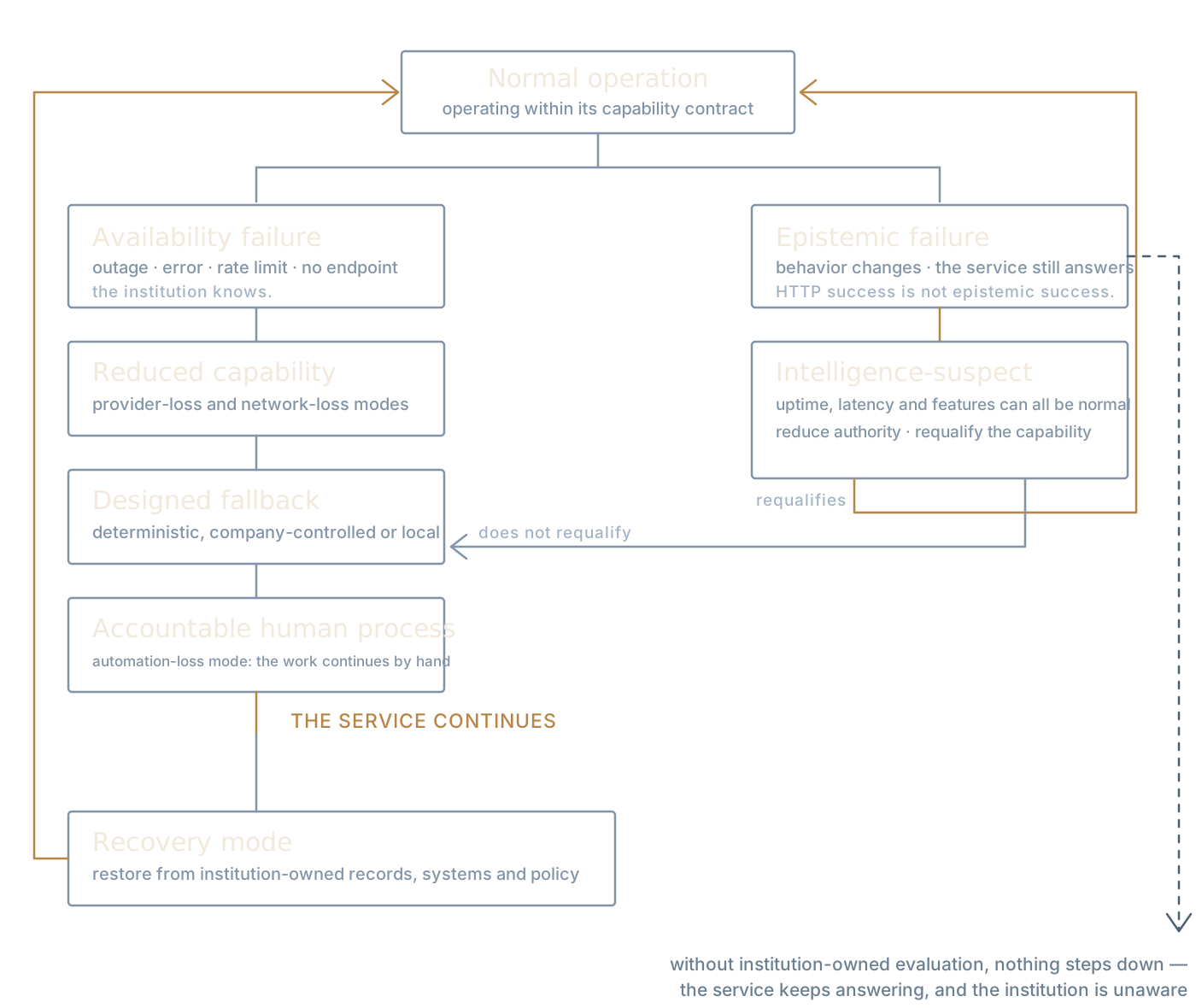
A capability can fail in two different domains, and only one of them announces itself. When a provider becomes unavailable, a designed system steps down through defined modes and keeps serving. When a provider's behavior changes instead, uptime and latency can stay perfect while the answers quietly stop being good enough — and that is only detectable if the institution is testing for it.

This is why Masters treats continuity, authority, and provenance as architectural inputs rather than governance paperwork applied afterward.

An external capability can fail in two separate domains. An availability failure — an outage or error — is legible, and a designed system steps down through reduced capability, a designed fallback and accountable human process while the service continues. An epistemic failure is different: institution-owned evaluation may detect that behavior has changed while uptime, latency and features all remain normal, leading to intelligence-suspect mode where authority is reduced and the capability is requalified — returning to normal operation if it requalifies, or joining the fallback path if it does not. Recovery mode restores normal operation from institution-owned records, systems and policy. Without institution-owned evaluation, an epistemic failure is never detected and the service keeps answering while the institution is unaware.

Evidence architecture

Every consequential claim carries its provenance.

A recommendation is only as trustworthy as the evidence behind it, so each material vendor or technology claim is designed to expose its source and the date it was observed.

  1. 01

    Dated observations

    Claims record when they were observed. A report should not silently change because the market moved after it was generated.

  2. 02

    Source and maturity

    Each claim preserves its source, source type, maturity, and confidence, and can be marked superseded when newer evidence replaces it.

  3. 03

    Interpretation kept separate

    Masters' interpretation of a fact is distinguished from the fact itself, and from what a visitor told us about their own situation.

  4. 04

    Reconsideration triggers

    Where practical, evidence records what would cause a conclusion to be reconsidered — so a claim is falsifiable rather than merely asserted.

Publications and records

What Masters publishes.

Individual research records — technology comparisons, prior-art reviews, negative results and architecture decisions — are published as dated Masters Findings, each carrying its method, its limitations and the conditions that would change its conclusion.

Competitive audit

Sixteen organizations, assessed one at a time

Business SWOT and positioning across platform, security, governance, data, and consultancy substitutes — assessing how each actually creates value and dependence, not how its marketing describes it.

Observed 2026‑09‑02 · standing conclusion: no end-to-end substitute demonstrated
Evidence architecture

Vendor intelligence with dates attached

Claim, source, observed date, maturity, confidence, interpretation, and what would cause reconsideration — the corpus the Guide reasons over.

Bounded first corpus — not comprehensive market coverage

Provisional research

Governed Institutional Intelligence

A research direction and a set of open questions about institutional memory, ownership, authority, and continuity.

Explicitly provisional — not a validated offering

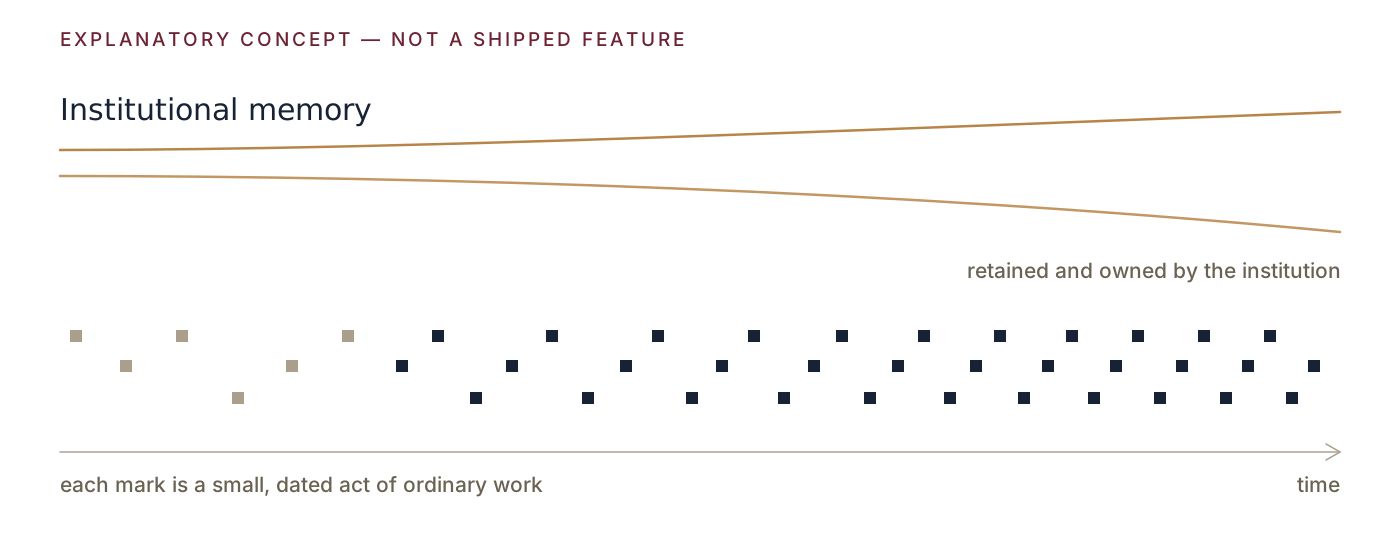
A conceptual sketch: many small dated acts of ordinary work accumulate over time into institutional memory the organization continues to own.
The contribution graph is explanatory language for a future operating concept — a way of describing how ordinary work might accrue into institutional memory. It is not a shipped feature.

Open questions

What Masters is still working to answer.

  • How should an institution measure its own dependence on external intelligence over time?
  • Which decisions must remain deterministic and accountable, regardless of model capability?
  • What is the minimum evidence needed before a vendor claim belongs in a client-facing recommendation?
  • How is capability best retained inside an institution while still using external tools?

Negative results matter as much as positive ones. Reporting where an approach did not work, or where evidence is currently too weak to support a recommendation, is part of the standard.

See the evidence applied — use the Masters Guide