Approach
Diagnose before prescribing.
A technology can be impressive and still be the wrong intervention. We begin by understanding what the organization is trying to accomplish, where the system is failing, what people need to be capable of doing, and what a better operating state would actually require.
Institution first Architecture before product No-buy is a real answer
Is this actually an AI workload?
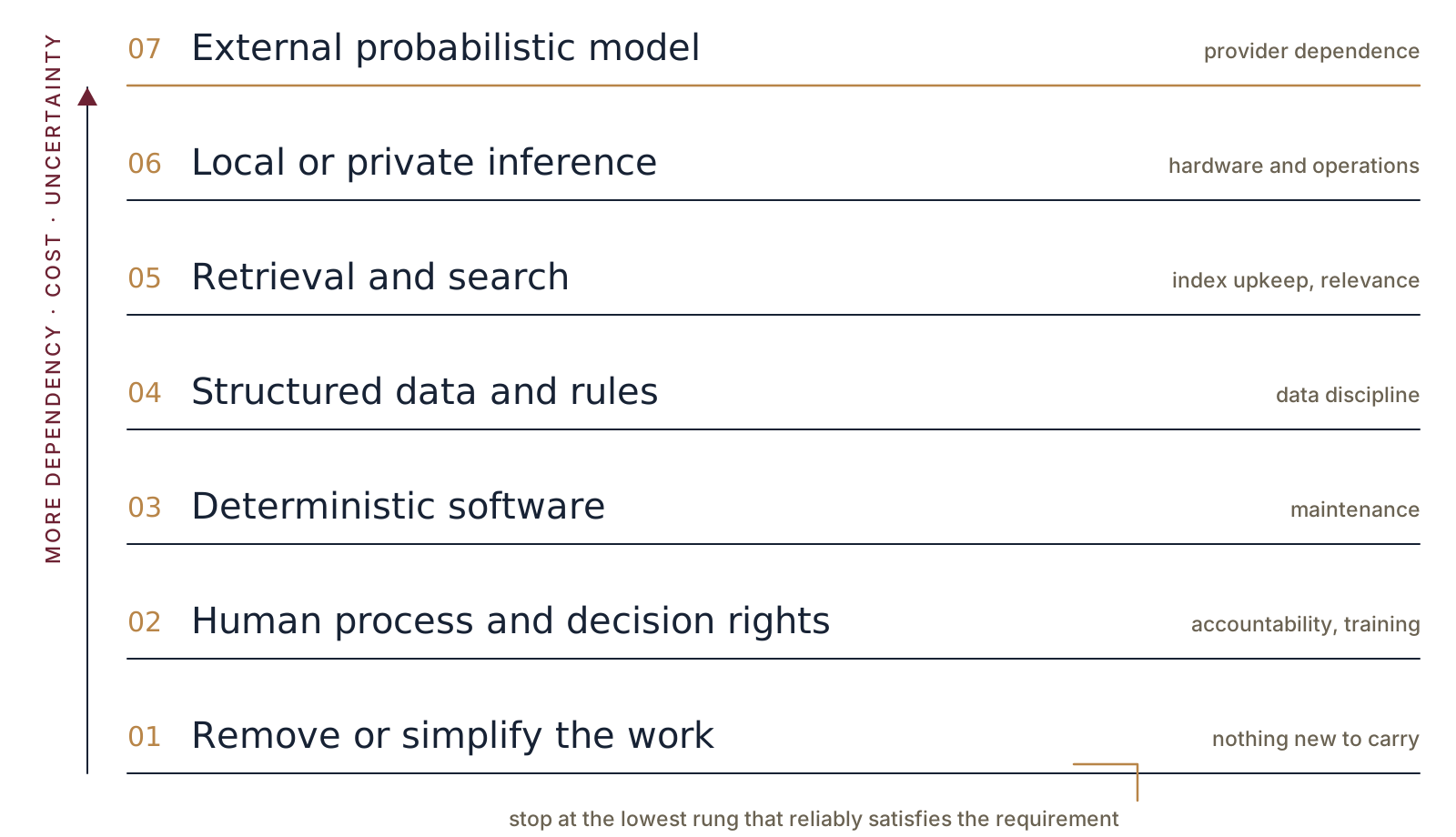
Architecture reduction
Use the least complex architecture that reliably satisfies the requirement. For AI-enabled work, this means separating what is known and repeatable from what genuinely benefits from probabilistic inference.
The comparison can include conventional software, rules and structured data, retrieval, local or edge inference, on-premise models, external model APIs, RAG, agents, and hybrid designs. Privacy, latency, resilience, auditability, maintenance, vendor dependence, and recurring inference cost are architectural inputs rather than afterthoughts.
A system is not more advanced merely because more of it depends on AI.
Consulting sequence
From objective to operating evidence.
- Business objective. What outcome matters, to whom, over what horizon, and under what constraints?
- Economic or operational bottleneck. Where is value being lost, delayed, exposed, or left unrealized?
- Existing process and system. How does work actually move today, including people, exceptions, handoffs, information, training, and informal workarounds?
- Decision rights and accountability. Who decides, who acts, who approves, who bears the consequence, and where is ownership unclear?
- Technology, automation, or capability opportunity. Which parts of the system could improve through simplification, better role capability, integration, deterministic software, local intelligence, automation, AI, or better information?
- Authority and risk boundaries. What may a system do, what requires human judgment, what information should remain customer-controlled, what evidence must be retained, and how should failure surface?
- Implementation design. Translate the decision into requirements, owners, sequence, controls, capability development, operating artifacts, and adoption work.
- Measurement and operating feedback. Define how the organization will know whether the intervention improved the system and what should change next.
Decision discipline
The solution space stays open long enough to make a real choice.
Before implementation, the alternatives should remain explicit. Depending on the problem, the right move may be to:
“Buy nothing” and “keep what you have” are on that list for the same reason every other option is: because the evidence, not the engagement, decides. Masters stays independent of the answer until the diagnosis points to one.
What the institution keeps
The institution is the enduring intelligence system.
Every recommendation is measured against what the organization retains afterward: its memory, its authority over consequential decisions, its ability to keep operating when a vendor or model changes, and its capacity to govern the system it now owns.
Read the Governed Institutional Intelligence researchOutputs
- 01
Decision artifacts
Problem frames, option comparisons, decision criteria, priorities, and roadmaps.
- 02
Operating artifacts
Process maps, standards, roles, controls, requirements, workflows, capability models, reference architectures, and governance.
- 03
Measurement artifacts
Success criteria, evaluation plans, feedback loops, risk signals, performance evidence, operating-cost measures, and operating reviews.
The exact artifacts depend on the engagement, but the work is oriented toward things an organization can use after the meeting ends.
First principle
The recommendation has to survive contact with the organization.
A theoretically optimal design that cannot be governed, adopted, afforded, understood, staffed, secured, or maintained is not an optimal design for that organization.